
The Earth Friends Approach & Framework
Earth Friends curriculum
Climate change is a global challenge, and environmental education is a global opportunity to unite a generation beyond race, gender, and geography. The children who become friends with all life on Earth will grow into the stewards of Earth we so need.
Earth Friends is an environmental awareness and literacy curriculum designed for children ages 3–6. The curriculum contains 25 lessons within 5 modules that focus on integration within the current curriculum or community and encourage play-based learning and whole-child development.
the Earth Friends approach
There are 3 pillars that set Earth Friends apart and above from the current early childhood environmental programs available.
integration
Environmental education and literacy must be embedded throughout our daily routines, interactions, and activities with young children. This requires an integration of both time and space. The duration of Earth Friends is designed for environmental literacy to be a weekly, if not daily, aspect of a child’s learning and play.
Earth Friends is not a unit of study.
Each lesson and activity are within the context of a young child’s impact on the world around them (their own school, their home, their neighborhood) and within their realm of comprehension. Earth Friends is actual rather than aspirational, asking the school or community to model behaviors.
The school or community’s integration allows a young child to engage in these new-to-them behaviors and develop a community of like-minded young children. These children, who have been given a sound foundation and understanding of their environment and their impact on it, will naturally evolve into children who have been permitted the self-agency to be an important part of their world. These are our future environmental stewards and climate activists, our innovators and leaders, our growers and our creators.
The success of integrating environmental education into the preschool curricula depends on certain criteria including:
hands-on, developmentally appropriate activities
creative and play-based learning
movement, gross and fine motor skill activities
repetition of concepts and information through movement, music, and routine
encouraging community events and initiatives that incorporate families and friends
instituting sustainable and regenerative routines and practices throughout the operations of the school or early education center
communicating with parents and families to offer additional resources and activities to coincide with each lesson
self-agency
When adults discuss climate change or environmental topics, the conversation is rarely joyful or optimistic. Climate change brings out our fear and our anger. Seeing our destroyed natural world is heartbreaking, and climate anxiety is real. Earth Friends does not dismiss these realities; however, we must consider that fear, anger, and anxiety is not the story of our children. This young generation has an opportunity to rewrite the story. Earth Friends educates and introduces children to their self-agency.
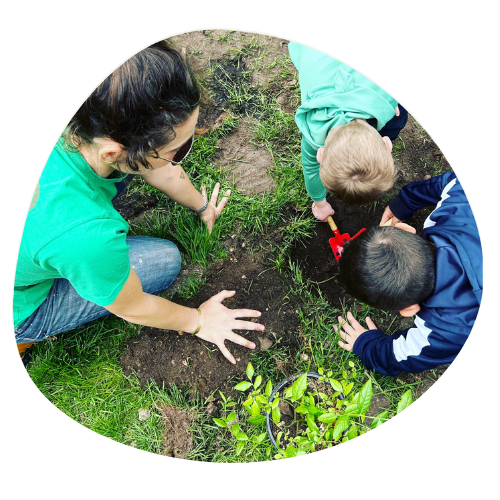
The Earth Friends curriculum begins each module at the most basic level of learning and discovery, and each lesson builds and advances from that point. It is important that Earth Friends Educators approach the lesson material as a learner—adults as co-learners. When adults have all the answers, they can stifle a child’s curiosity or squash their courage to share what they think.
There are no wrong answers in Earth Friends.
Curious Questions invite the children to explore all angles on every subject through engaged discussions. Hands-On Activities and modeling behaviors exercise experience-based learning. Movement Activities develop gross and fine motor skills. Science Activities and Discovery Activities give the children the opportunity to form and share opinions based on observation. Creative Activities encourage interpretation and expression through art.
We cannot simultaneously give children the reins and direct them. Telling children what is right and wrong or how to think and feel further exacerbates the current environmental, sustainability, and equity challenge—how to instill inherent and intrinsic behaviors of awareness and preservation in human beings. Earth Friends is the chance for children (and adults alike) to get to know our planet and to pay attention to our world. To learn about where we live and how we live.
positivity
As Earth Friends Educators, our role is to lead with love and possibility. While each module touches upon a current global concern—climate change, biodiversity loss, food waste and scarcity, energy pollution, and overconsumption—identifying global concerns is not the objective of this curriculum.
As an example, biodiversity loss is indisputable, but Module 2: Our Neighbors does not focus on habitat loss or species extinction. Our Neighbors introduces children to the variety and beauty of all living things, our ability to share our home, and the unique way all life on our planet is interconnected.
Young children do not need to be burdened with our fears. Young children need to be emboldened by their love for what surrounds us and sustains us. Earth Friends asks adults to practice positivity, to see our world through a child’s eyes.
As Educators become co-learners, they rediscover the uniqueness of life on our planet, the interconnectedness of nature, the positive impact of human beings, and the kindness of community. Adults, as well, are invited to be in awe of our world and to reinvigorate our own motivations to live more in harmony with all that surrounds us.
There are 5 tenets designed for Earth Friends to go above and beyond the current approaches to environmental education in early childhood.
curriculum structure
Ages: 3–6
Lesson Length: 20 minutes
Curriculum Duration: 30 weeks
Overall Objective: Establish beliefs and behaviors in young children that lead to actions of love and respect for our natural and built environment, other people, and their own health and well-being.
5 Modules:
Our Planet
Our Neighbors
Our Food
Our Energy
Our Things
Each Module contains:
5 lessons:
Learn (grasping a concept)
Understand (integrating a concept)
Observe (witnessing a concept)
Connect (relating to a concept)
Love (exercising agency in relation to a concept)
Activities: Such as, hands-on experiences, creative projects, discovery moments, gross and fine movement, and science experiments
4 Vocabulary Words
A Community Gathering
Integrated School Activities and Commitments
Each Lesson contains:
Curious Questions
Good Choices
An Activity (see above)
Teacher Activity and suggested
“Throughout the Week” Lesson Integrations
Activities and Discussion Prompts for Parents and Families
To bring a very important concept of early childhood learning—music and movement—into this approach, the curriculum includes the “Earth Friends” song, which connects the children to music through lyrics that draw attention to the five modules and encourage movement through American Sign Language.
You can find “Earth Friends” in the resources section below.
assessment tools
We are not here to grade or evaluate the children, but it is worthwhile for any early education curriculum to provide tools to assess a child’s engagement, development, and interests. There are several tools available that can help any Earth Friends Educator be in tune with each child’s experience of Earth Friends.
Vocabulary
Each module includes a set of 4 vocabulary words that are introduced and repeated throughout the material, lesson by lesson. These are words and terms that build the foundation for environmental and sustainability understanding as it applies to our world today. Along with self-agency and a love for their planet, we want to arm children with a voice and a vocabulary.
Each of the vocabulary words is also referenced in the Photo Books for each module, and another source for these new words is in the lyrics of the “Earth Friends” song.
To assess vocabulary:
Observe when a child is using new words in play and learning
Observe when a child asks questions in relationship to a word’s subject
Creative Portfolio
The suggested medium for the majority of Earth Friends Creative Activities is plain paper and Crazy Crayons (available for purchase through Earth Friends online store), which supports 2 values.
It supplies a consistent form of expression so that each child can build a portfolio of their drawings. This provides an opportunity to observe how the child is understanding and connecting to the material presented. We each have our own “favorite” connections to Earth, and that cannot be helped. One child may create art that includes animals with many colors, while another will draw humans who make robots. Get to know the child through their portfolio, and also watch the changes that may occur over time.
It encourages sustainable choices for artistic expression. By using paper and Crazy Crayons, Earth Friends does not promote the use of disposable art supplies, traditional glitter, glue, and treated papers. While beautiful works of art come of these materials, these works of art will end up in a landfill in time. Drawings on untreated paper can be composted, or at the very least will not contribute to more plastics and microplastics in the environment.
resources
KWL Chart
Know - Wonder - Learned can be a great method of charting the impact of Earth Friends. Whether you choose to make a classroom KWL chart or a KWL for each child, a KWL chart for each module makes a valuable assessment tool.