
Module 1: We Love Our Planet
We Love
Our Planet
OBSERVE
Student Learning Standards and Additional Lessons, Materials & Activities by State
New Jersey
Objective: to observe our weather. Different places on Earth feel different-hot or cold, wet or dry-and these are called climate zones. Different times of the year can have different weather-cold and snowy, hot, and sunny. Weather can change every day where you live but your climate zone stays the same.
Vocabulary: climate zone
Reading: Here We Are
Hands-on Activity: Climate Zones

Earth Friends Lesson
Module 1: Lesson 3
Begin Lesson
move: 5 minutes
Our Solar System
This is a repeated activity with ASL signs that describe a feature of each planet. If you repeat Our Solar System during each lesson of Module 1, the repetition will help the children learn that Earth is a planet in our solar system, and it is special because it supports life. We live on Earth!
We are going to learn about the different planets in our solar system. Every planet is special in its own way, and we are going to pretend to be the planets moving around the sun.
SUN: Our Sun gives us light during the day and all the energy we need to live. Make a C-motion away from forehead with right hand.
MERCURY: Mercury is the smallest planet. Squeeze 2 fingers together to indicate tiny.
VENUS: Venus is the brightest planet. Use 2 hands to fan out from center.
EARTH: Earth is our home and the only planet that supports life. Cross arms in front of chest for hug.
MARS: Mars has the biggest volcano. Form a triangle with index fingers and then make an explosion sign with right hand.
JUPITER: Jupiter is the biggest planet. Move hands apart from center.
SATURN: Saturn is the planet with rings. Draw a ring around right hand with left.
URANUS: Uranus is the coldest planet. Shiver.
NEPTUNE: Neptune is the farthest away. Point far away with right index finger.

Use the photo book to
familiarize the children with
photos of the planets.
Curious Question
What is the weather today? What holiday is coming up soon? What season are we in?
Continue to discuss holidays in each of the four seasons and what kind of weather we experience. This is a more involved curious question, and the goal is to have the children talking about all four seasons and the different weather and temperatures we experience.
Main Lesson
In the United States, we live in the Temperate Zone, where the weather and the trees change with each of the 4 seasons. In spring, it's cool and the rain helps the plants and leaves on the trees grow. In summer, it's sunny and hot and we can play in the water and the trees are big and green. In fall, it's cool and the trees lose their leaves. In winter, it's cold and sometimes snowy, and the trees don’t have any leaves. Earth has 3 climate zones and we are going to learn about them and which one we live in.
sit & learn: 5 minutes
Climate Zones
This hands-on activity will start to familiarize the children with the different climate zones located on Earth. Younger children may not fully grasp the conditions and locations of each, but they will begin to understand that Earth has different climate zones with different temperatures. You can use your Classroom Earth (instructions below) or the “Here I Am” Lesson printable materials found here in our Spinwheel, which includes a cut and color Earth + Climate Zones.
Materials Needed: Classroom Earth; climate zone markers (2 blue, 2 green, and 2 orange ribbons or strips of paper).
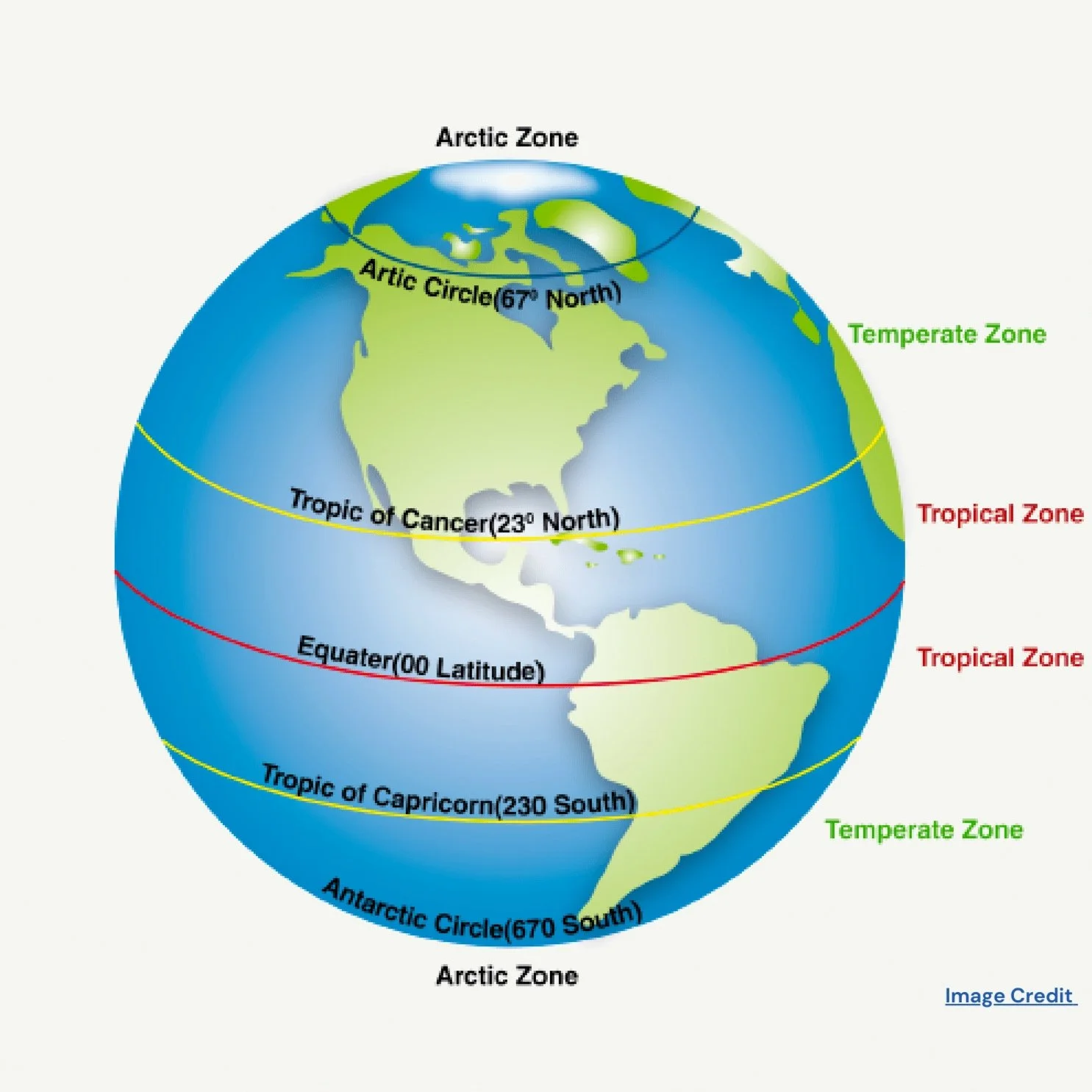
Take the Classroom Earth down and place it on the floor or on a table so the children can circle around to see. Introduce them to the 3 climate zones (Polar, Temperate, Tropical) in each hemisphere using the climate zone markers (ribbons). (You can refer to the graphic below.)
TEMPERATE ZONE: Many of us live in the Temperate Zone*. Point to the northern and southern Temperate Zones on Classroom Earth. Place to the 2 green ribbons down. Earth has 2 other climate zones.
POLAR ZONE: The Polar Zone is where it's very cold, snowy, and icy. Point to the northern and southern Polar Zones on Classroom Earth and place the 2 blue ribbons down.
TROPICAL ZONE: The Tropical Zone is right in the middle, across the Equator where it's hot. There is no snow there, and in some places it rains a lot and in other places it doesn't rain very much at all. Point to the northern and southern Tropical Zones on Classroom Earth and place the 2 orange ribbons down. The tropical zone ribbons will be beside each other, on either side of the equator, which may bring up a deeper discussion of Northern and Southern Hemispheres.
* “Many of us live in the temperate zone” may not be you. Order the zones in relationship to wear you live.
Once you have shown the children where the climate zone markers go, you can have them take turns placing them.
Are you ready to place the Climate Zones on our Earth? Who wants to go first?
Have the children take turns placing the Climate Zone markers on the Classroom Earth. Depending on the number of children, 2-3 rounds are sufficient (that's 6 children a round, 1 for each Climate Zone).
Closing Sentiment
Some places on Earth are always cold. Some places are always hot. Others have more rain or are hot and dry. Places like where we live have 4 different seasons. We call these different places that share the same temperatures climate zones. We have 3 climate zones.
move & learn: 10 minutes

End Lesson
Teachers in the Classroom
Teacher Activity
Weather Report
Materials Needed: Drawing medium + drawing utensils, such as butcher paper + Crazy Crayons
Ask the children to draw what the weather is like outside today*.
Prompts:
What is the land like today? (muddy, wet, grassy, sandy...)
Is there water outside today? (raining, snowing, puddles, dry ...)
What do you see in the air today? (clouds, sunshine, storms, rainbow...
*You can offer this as a daily activity over a week or a weekly activity over a month or year.
Throughout the Week
Discuss: the different kinds of weather during different seasons in your area.
Hands-on: Take the Classroom Earth down and help the children take turns placing the Climate Zone markers on it. Remind them with each one what that climate is like.
Create: Continue to glue fabric to the Classroom Earth to finish making the mosaic.
Reading: Here We Are
Vocabulary: Earth, natural element, climate zone
Good Choices
When it's cold outside, I can wear my coat to keep my body warm.
My umbrella keeps me dry in the rain, but since it doesn't rain inside, I can keep my umbrella closed inside.
When I'm running around outside and getting hot and sweaty, I can drink water to stay healthy and hydrated.
Vocabulary:
Earth: Earth is the only planet where we humans, animals, and plants can live. This makes Earth very special. Earth is not too hot and not too cold. It's just right for life.
natural element: Earth has 3 natural elements that make it a good home for humans like you and me. Land, Water, and Air. Animals and plants need land, water, and air too.
climate zone: Earth has 3 climate zones. The Polar Zone is cold, and the Tropical Zone is hot. In the Temperate Zone, the weather changes every season. In spring, it's cool and the rain helps the plants grow. In summer, it's sunny and hot and we can play in the water. In fall, it's cool and the trees lose their leaves. In winter, it's cold and sometimes snowy. Our zone is unique because our seasons are so different
Families at Home
Discuss: the weather! We learned about how the weather can change every day. What is the weather like today? What do we do when it's hot out? Cold and snowy?
Explore: We learned about what the 3 climate zones feel like. The Polar Zone is cold and wet (the Arctic). The Tropical Zone can be hot and wet (a rainforest) or hot and dry (a desert). The Temperate Zone, where many of us live, has 4 seasons and all kinds of weather. Using household items, safely explore these characteristics with your child.
What is hot? Examples: water from the sink, a fire, a heating pad
What is cold? Examples: ice, a rainy sidewalk, toes without socks
What is wet? Examples: raindrops, your tongue, milk
What is dry? Examples: clothes, paper, your hair
You can also pair 2 together, such as warm and wet (the bath water) or cold and dry (a strawberry in the fridge)
© Earth Friends Incorporated | earthfriends.us