
Videos to Enrich Your Teaching (teachers call this PD)
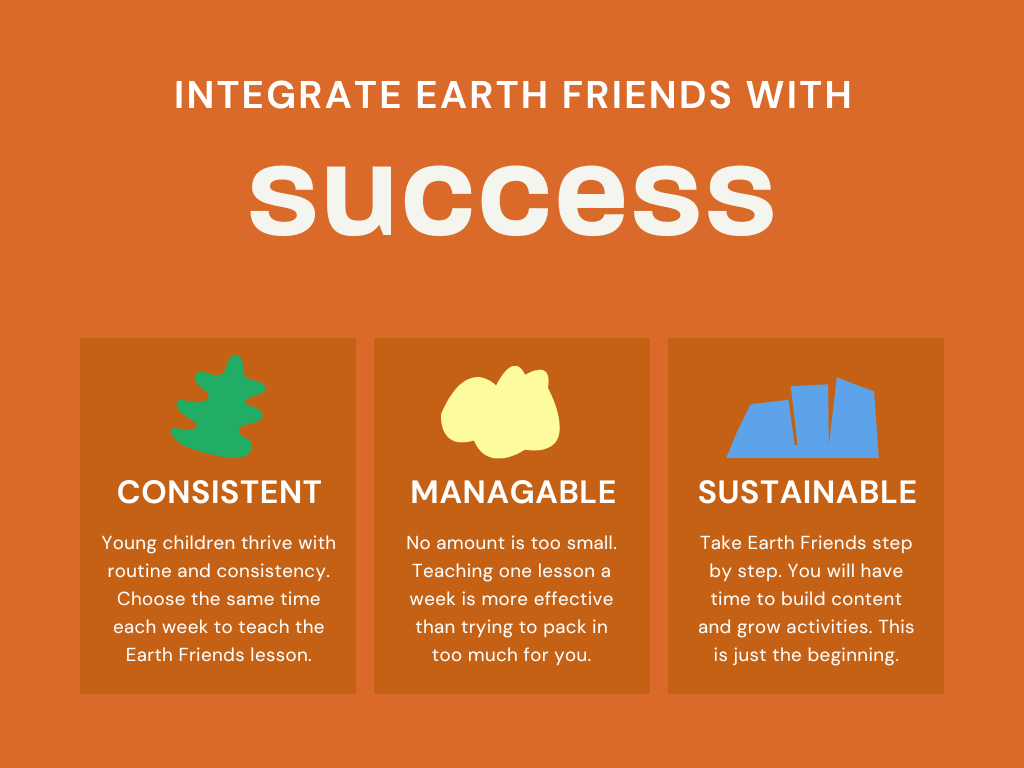
Set Up For Success
offline exercise
what you’ll need:
20 minutes (or as much time as you like)
a pen + notebook (or whatever you take notes with)
1. Consistent
Before you get too excited about the content you are going to introduce to your classroom—the activities or lessons—it is best to choose a consistent time* to teach environmental education or engage in activities. When you are consistent you can set expectations for children, and expectations will lead to excitement.
Choose a frequency. Do you want to use Earth Friends once a week, twice a week, or a number of times a month? What days work best for your classroom? Where could this content align with what you are already doing on given days.
Choose a time. Do you bring Earth Friends to circle time in the morning? Or right after lunch or nap? What are the parts of your day that would align with a lesson or activity.
Consistency will help ground this content into your class as a routine rather than a unity of study, project**, event, or holiday. When environmental education becomes a routine, this helps children see how it applies to all times of year, all holidays, all seasons, and in alignment will other content throughout the year.
*We recognize that certain schools and learning spaces are not curriculum-driven and use child-centered approaches. In this case, a consistent time would not fit into your days in the same way. However, you can see “consistency” as the number of times you offer or explore certain content in a given time—a day, week, month. Explore what consistency could mean for you, even if that is as simple as connecting Earth Friends content to child curiosity one time each week.
**There are some classrooms and schools that center around project-based learning. In this case, consistency would be exploring how the Earth Friends content can align with a set number of projects a month or a year.
While “consistency” might feel rigid in some settings, consistency leads to success because it will expand environmental education over times. The intention here is avoid going long stretches without Earth Friends content.
2. Manageable
Earth Friends is designed to enrich your classroom rather than add something to your plate. The familiar adage “Don’t bite off more than you can chew.” applies here. You can even go back to your notes from Video 2 to see where Earth Friends aligns with your values, because that will give you an idea of what content you will excited to add (Activities… Vocab? Lessons!) and what content will feel a bit daunting to you (Lessons… Vocab? Activities!).
What is one aspect of your classroom or curriculum that aligns with Earth Friends content?
Where are you already introducing children to the natural environment?
How can enrich what you are already teaching by introducing content about the built environment and our human impact?
Make sure you start with what you can actually do with your class (and your time) instead of what you potentially want to do or could do. Start small. Plant a few seeds. Watch them grow. You will soon know what you can and what you would like to include next.
3. Sustainable
Let’s not burn out. Sustainable is something that last in the long term. In order to last in the future, make a plan for the future. You can make a 5-year Earth Friends Plan or an Earth Friendly wish list.
Take some time to go through the sustainable school supports and integrations. Make notes about what you want to do or add to your school or learning location. If it is a small scale project, you could make a plan to include it in year 2. However, if it is project that requires time and budgeting, determine what you will need—and possibly who in your community can support you.
If you feel so inspired, you could take this further with a vision board or some free writing to help you see your school or classroom’s activities and routines 5 years from today. What do you want to change, drop, or add? What are all the ways you will be enriching your teaching with Earth Friends in 5 years?