
Module 4: We Love Our Energy
We Love
Our Energy
OBSERVE
Objective: to observe that some of the energy Earth gives us can be used again and again and some of the energy Earth gives us will run out
Vocabulary: renewable
Reading: Earth Hour
Discovery Activity: Power Tower

Earth Friends Lesson
Module 4: Lesson 3
Begin Lesson
move & discover: 5 minutes
Earth’s Energies
This is a repeated activity the children can do at the beginning of the lesson each week. This will help familiarize them with the different sources of energy that Earth provides.
We get energy to make and move and change things from Earth through our land, water, air, and sun.
LAND: Stomp your feet. Feel the land. We can dig up fossil fuels, like coal and oil, that we find buried deep down underground and burn them to make energy from fossil fuels. We can also pump up very hot water or steam that we find deep underground to make what is called geothermal energy.
WATER: Can you move your body like a wave? Throw your hands up in the air like a big, tall wave. Now let your hands come down like a wave crashing. That's called hydropower energy and that comes from moving water. Water move from up to down, like waves on the ocean or falling down a waterfall. There is a lot of water all over Earth that can give us energy.
AIR: Can you blow on your hand in front of you? Can you feel the air move on your fingers? The air is full of wind, and wind makes energy that we call wind power. Changes in Earth’s air temperature make wind.
SUN: Close your eyes. Can you see? The sun gives Earth a lot of light. We need light to see, and light also gives us energy. It's such a bright light we can't look right at it, but it can sunlight up our world and we can make that light into energy through solar power.
Curious Question
I wonder what happens if we run out of energy.
Allow the children to share what they think happens if we don't have any energy or power left. This might be the first time they thought about something like this, so it's okay if no one has much to say or if the children offer suggestions that don't relate.
Jumping Jacks
Stand in a circle or a line, making sure there is plenty of personal space for everyone.
Ready to use your own energy? We are going to do Jumping Jacks*. See how many you can do. When your body feels tired, you can sit down to rest.
Once everyone is sitting down, take 5 calming breaths together. Talk about how that used up all your energy. Good thing we have more from all the healthy food we eat!
*You may need to teach jumping jacks, and if that is the case take one motion at a time—and do the motions with the children.
FIRST, jump up and clap your hands overhead. Do this 5 times.
NEXT, jump up and jump your feet wide. Do this 5 times.
NOW, we’re going to move our hands and feet together! When you jump clap your hands over your head and jump your feet wide.
Who can do this 5 times?
Main Lesson
It takes Earth millions of years to make the fossil fuels buried down deep underground, like the coal we mine and the oil and nature gas we pump up and drill from down deep with through pipes. Energy, like fossil fuels, that we cannot make more of is called nonrenewable. We can capture sunlight on a solar panel over and over, and we every time the wind spins a wind turbine, we get energy. Energy we have more of, like solar, wind, hydropower, and geothermal is called renewable energy.
sit & discover: 7 minutes
Power Tower
This experiment will show the children how temperature creates wind and how wind can create power.
Materials Needed: 2 tin cans, pinwheel* paperclip, thumbtack or straight pin, tape, votive candle, lighter, pot holder, 2 books
Preparation:
Clean and then remove the tops and bottoms of the 2 tin cans.
Create a wire arch to go over the opening of 1 can with the paper clip and tape to either side.
In the center of the arch, tape an upside-down (sharp end up) pin or thumbtack.
Stack the 2 cans on top of each other and secure them with tape, so the pin or thumbtack side is at the top.
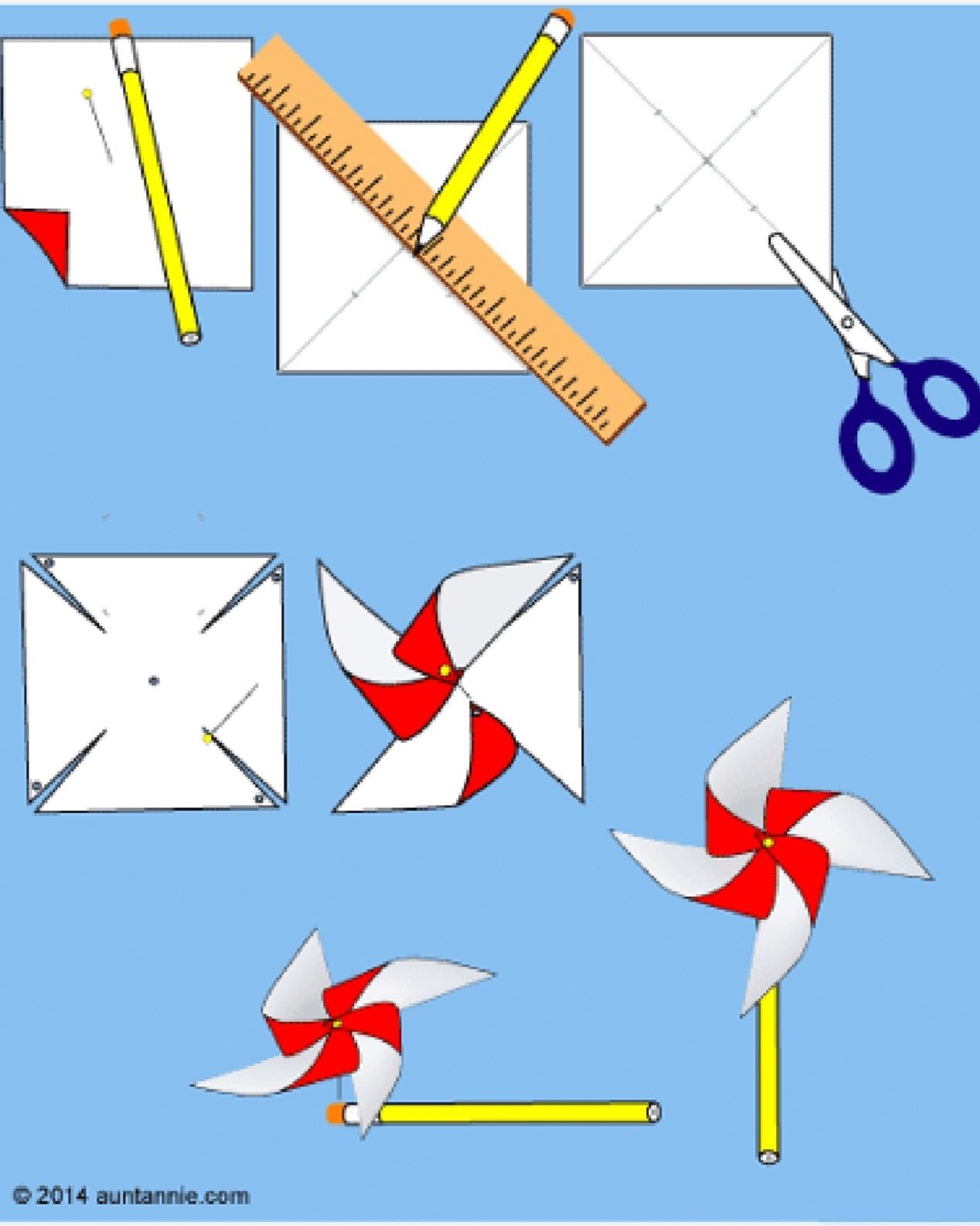
Use a pinwheel or craft a pinwheel with help from the image below. Once you have your pinwheel, make an indent in the center with a pencil or pen tip (but don't poke through)
Gather all the children to sit down in circle or at a table, anywhere they can observe with their eyes. Once, everyone is sitting down, bring your preassembled tin can tower into the center of the circle and place it on 2 books (so there is airflow underneath). Place the pinwheel center (upside down) on top of the pin or thumbtack. Let them observe how the pinwheel is not moving. There is no energy.
What do you see? What is happening? Is anything moving?
There is a chance that children will try to blow it, and if that happens remind them that they are observers today, learning with our eyes not our mouths or hands or bodies. Watch this with your eyes.
Place the tower over a lit candle. Ask the children to wait (good time for calming breaths) and see when the pinwheel starts to turn.
What is making it move? What is powering the tower? What do you see?
Allow the children to share anything they see happening, whether it is scientifically correct or not, whether it has anything to do with energy or not. The objective is to help them learn to observe differences.
Closing Sentiment
Humans use a lot of energy, and Earth gives us energy that we won't run out of, called renewable energy. Renewable energy comes from the sun, the wind, the water, and the land.
watch & learn: 7 minutes

Use the photo book to show the children the different kinds of energy we get from land, water, air, and sun.
End Lesson
Teachers in the Classroom
Teacher Activity
Recycled Pinwheels
Ask the children to find a piece of paper that they would like to reuse. This can be a drawing or anything considered paper in the classroom. Or you can decide ahead of time to save drawings for this purpose-to show reuse and recycling. They can keep their paper as is or add more color or drawings for their pinwheel.
We are going to make old pieces of paper into new pinwheels! Everyone's is going to look different. Next, everyone needs a stick for their pinwheel.
Use older art supplies or save straws from lunches to reuse. Let everyone's stick be different to show how we can reuse things. Another option is to go outside and find sticks in nature.
What can you use for a stick for your pinwheel? Let's look around.
Remember, here is how we make a pinwheel.
To the best of your judgment, guide each child
to cut and assemble their pinwheel.
This may take a lot of time and a lot of mistakes,
but it is a chance to learn and use their hands.
Older children may use scissors, while younger
children may need more help from an adult.
Throughout the Week
Discover: solar power. Using the tin can tower, you can show the children how solar power works. On a sunny day, get out the tin can tower. Remind them that they can move the pinwheel with wind, with heat, and now what else? Set the tower in a sunny spot. In the beginning the pinwheel will not move, but as the tin cans heat from the sun's rays, the pinwheel will start to spin. When you set the tower in the window, ask who is going to see the pinwheel move first? What is moving the pinwheel this time?
Learn: why humans need energy. Using the photos in We Love Our Energy, ask the children why each thing needs to use energy. Examples: Planes go. Factories make. Trucks haul. Refrigerators cool.
Reading: Earth Hour
Vocabulary: energy, power, renewable
Good Choices
I can save energy by turning off the lights or TV or anything else l am not using.
I can learn about renewable energy like wind, water, and sunlight.
I can learn where the energy we use comes from.
Vocabulary:
energy: Energy makes things move, change, and grow.
power: Humans use energy every day. We need energy to make things move and go and work. We call this power.
renewable: Some of the energy Earth gives us can be used again and again like light from the sun, movement from water, and wind in the air. When we use these energies, we won't run out of energy. Energy that we use again and again is called renewable.
Families at Home
Visit: Plan a Science Playdate to your closest science center with a fellow Earth Friend. This week, we've been learning about the kind of energy we are never going to run out of and where it comes from.
Discover: your own energy. Have a dance party to move your body when you hear sound. Go outside and find a big open space to run and feel the wind. Find a pool and go swimming. We move our bodies with the elements and energies in all kinds of ways.